Capital · 2026
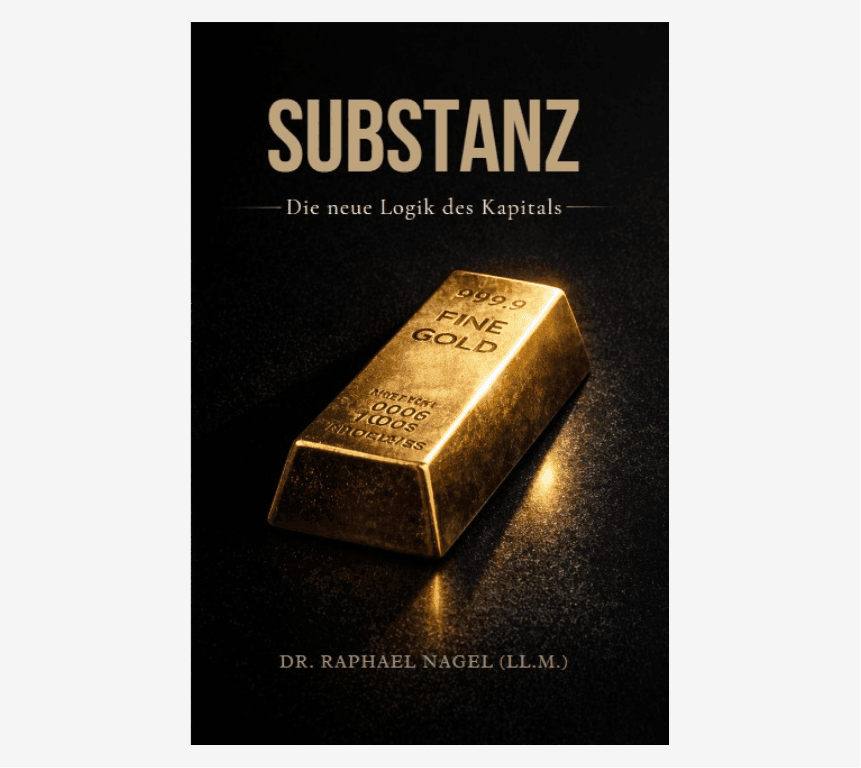
SUBSTANZ
Real-assets thesis: scarcity, hard currency, capital with backbone.
ISBN 978-3-912703-25-2 · First edition
About this book
Published in 2026 as part of the Capital series, this title belongs to Dr. Nagel's body of work mapping how capital, regulation, and strategic position interact in the European economy. The arguments developed here also surface across the editorial essays linked below — each essay extends one of the book's core threads with a specific case, regulatory reading, or operational pattern.
- Part of the series
- Capital
- ISBN
- 978-3-912703-25-2
- Published by
- Tactical Management — the author's investment firm and editorial home.
How this book is meant to be read
Dr. Nagel writes for operators rather than analysts. Each chapter opens with a structural claim, develops the case through specific actors and time horizons, and closes with a falsifiable test rather than a recommendation. The arguments are deliberately uncomfortable — that is the standard of care his readers expect. The book is short by design: the value is in the precision of the framing, not the volume of supporting material. Most readers finish the volume across two or three sittings and return repeatedly to specific chapters when a decision arrives. A linked-essay map at the foot of this page extends each argument with a current case study or a regulatory development published since the book went to press, so the reader can confirm whether the framework has held.
Why this argument matters now
European decision-makers — board members, fund managers, family principals, senior policy advisors — are operating under a tighter set of constraints than at any point in the last two decades. Geopolitical fragmentation, regulatory acceleration, the AI displacement of expert work, and the demographic transfer of Mittelstand ownership are running in parallel rather than in sequence. The books in this catalogue are written for that moment. Each one isolates a single decision frame, names the actors and obligations involved, and provides the language a serious reader needs to make defensible choices when partial information is the only kind available. Where standard advisory output measures complexity through caveats, Dr. Nagel measures it through commitment to a position that has been tested against counter-cases and adversarial reading.
About the author
Dr. Raphael Nagel (LL.M.) is Founding Partner at Tactical Management. A German-Spanish national, lawyer, and author, he has worked at the intersection of capital, governance, and strategic transformation for more than two decades. Recognition includes Forbes Most Inspiring Corporate Leaders 2021 and Business Worldwide Magazine CEO of the Year, Financial Services UAE 2020. He is the author of more than thirty books on capital, leadership, geopolitics, security, and sovereign technology.
Full biography →Essays from this book
2026-05-18
The Limited Gin: A Case Study in the New Substance
A reflective essay on limited spirits collector value, drawing on Dr. Raphael Nagel's SUBSTANZ to examine why closed distilleries, verifiable narrative and...
2026-05-18
The Great Abstraction: How Derivatives Displaced Substance
An editorial essay drawing on Dr. Raphael Nagel's book SUBSTANZ, tracing the long journey from the bill of exchange to the credit default swap, the collapse...
2026-05-17
The Crypto Paradox: Scarcity Without a Body
An essayistic reflection by Dr. Raphael Nagel (LL.M.) on why Bitcoin's programmed scarcity identifies the right problem of our time, yet fails to deliver...
2026-05-16
Diversification as Distraction: A Critical Revision
An essayistic reading of Chapter 15 of SUBSTANZ by Dr. Raphael Nagel (LL.M.), which argues that breadth across correlated paper instruments is not...
2026-05-12
Paper Wealth and the Silent Expropriation of the Middle Class
An editorial essay by Dr. Raphael Nagel (LL.M.) on how bonds, life insurance policies and savings accounts quietly erode middle-class wealth through...
2026-05-12
The ETF Fallacy: Buying the Index Means Buying the Average
An essayistic reflection by Dr. Raphael Nagel (LL.M.) on the structural limits of index funds, the correlation trap in crisis moments, and the quiet case...
2026-05-11
Family Capital and Generational Strategy in the Logic of Substance
An editorial essay by Dr. Raphael Nagel (LL.M.) on family wealth inheritance, substance, and the generational logic of capital drawn from the book SUBSTANZ....
2026-05-05
Control Beats Return: The Forgotten Principle of Wealth
An essayistic reflection on why operational control, not yield, defines real wealth. Drawing on Dr. Raphael Nagel's book SUBSTANZ, this essay examines the...
2026-05-02
Geopolitics of Physical Assets in a Fragmented Order
An essayistic reading of Dr. Raphael Nagel's SUBSTANZ, focused on Chapter 12: why sovereignty in a fragmented world order rests on physical resources, and...
2026-05-01
The Nixon Shock and the Silent End of Monetary Substance
An essayistic reflection by Dr. Raphael Nagel (LL.M.) on the 1971 Nixon Shock, the quiet erosion of purchasing power, and the lessons that European savers...
2026-04-30
What Advisors Conceal: The Structural Conflicts of Financial Advice
An essay by Dr. Raphael Nagel (LL.M.) on the structural conflicts of interest in financial advice, the limits of MiFID II transparency, and the professional...
2026-04-29
Land, Stone, Object: The Three Pillars of Physical Substance
An essayistic reflection on farmland, real estate and collectibles as the three enduring forms of physical capital, drawing on Dr. Raphael Nagel's SUBSTANZ...
2026-04-28
Story Sets the Price: The Economics of Narrative
A reflective essay on narrative economics and provenance, drawing on SUBSTANZ by Dr. Raphael Nagel (LL.M.) to examine why verifiable, unchangeable stories...
2026-04-26
The Principle of Scarcity as the Foundation of Lasting Value
An essayistic reflection, drawing on Dr. Raphael Nagel's book SUBSTANZ, on why natural and permanent artificial scarcity form the most reliable basis of...
2026-04-20
Substance Investing Without Large Capital: A Method
Dr. Raphael Nagel (LL.M.) on how small investors enter physical substance markets through knowledge, narrow categories, and network discipline, not cash.