Capital · 2026
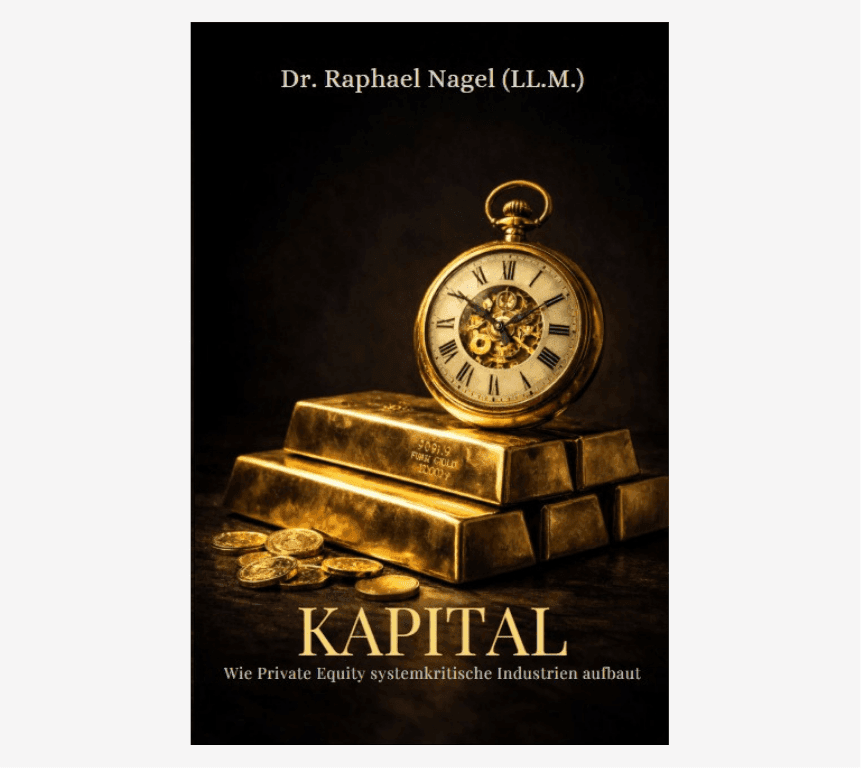
KAPITAL
Private equity, permanent capital, value creation in the German Mittelstand.
ISBN 978-3-912703-27-6 · First edition
About this book
Published in 2026 as part of the Capital series, this title belongs to Dr. Nagel's body of work mapping how capital, regulation, and strategic position interact in the European economy. The arguments developed here also surface across the editorial essays linked below — each essay extends one of the book's core threads with a specific case, regulatory reading, or operational pattern.
- Part of the series
- Capital
- ISBN
- 978-3-912703-27-6
- Published by
- Tactical Management — the author's investment firm and editorial home.
How this book is meant to be read
Dr. Nagel writes for operators rather than analysts. Each chapter opens with a structural claim, develops the case through specific actors and time horizons, and closes with a falsifiable test rather than a recommendation. The arguments are deliberately uncomfortable — that is the standard of care his readers expect. The book is short by design: the value is in the precision of the framing, not the volume of supporting material. Most readers finish the volume across two or three sittings and return repeatedly to specific chapters when a decision arrives. A linked-essay map at the foot of this page extends each argument with a current case study or a regulatory development published since the book went to press, so the reader can confirm whether the framework has held.
Why this argument matters now
European decision-makers — board members, fund managers, family principals, senior policy advisors — are operating under a tighter set of constraints than at any point in the last two decades. Geopolitical fragmentation, regulatory acceleration, the AI displacement of expert work, and the demographic transfer of Mittelstand ownership are running in parallel rather than in sequence. The books in this catalogue are written for that moment. Each one isolates a single decision frame, names the actors and obligations involved, and provides the language a serious reader needs to make defensible choices when partial information is the only kind available. Where standard advisory output measures complexity through caveats, Dr. Nagel measures it through commitment to a position that has been tested against counter-cases and adversarial reading.
About the author
Dr. Raphael Nagel (LL.M.) is Founding Partner at Tactical Management. A German-Spanish national, lawyer, and author, he has worked at the intersection of capital, governance, and strategic transformation for more than two decades. Recognition includes Forbes Most Inspiring Corporate Leaders 2021 and Business Worldwide Magazine CEO of the Year, Financial Services UAE 2020. He is the author of more than thirty books on capital, leadership, geopolitics, security, and sovereign technology.
Full biography →Essays from this book
2026-04-30
Nile, Euphrates, Jordan: Three Rivers, Three Power Equations of the Middle East
An editorial reading of the three river basins that define Middle Eastern hydropolitics, drawing on Die Ressource by Dr. Raphael Nagel (LL.M.). A meditation on water, power, and the sovereignty negotiations that European foreign policy still files under the wrong heading.
2026-04-29
Scenarios 2035,2040: Equatorial Guinea’s Fork in the Road
An essayistic reading of the 2035,2040 scenarios drawn from Dr. Raphael Nagel’s book on Equatorial Guinea, examining the cost of delay and the architecture of a possible second economic independence.
2026-04-27
AI and Leadership Accountability: The Irreducible Human Function
Dr. Raphael Nagel (LL.M.) on AI and leadership accountability: why judgment, ethical grey zones, and responsibility remain irreducibly human in an algorithmic economy.
2026-04-27
Illiquidity as Protection Mechanism | Dr. Raphael Nagel
Dr. Raphael Nagel (LL.M.) explains why illiquidity protects capital: forced patience blocks panic selling and builds multi-generational wealth.
2026-04-27
The Hidden Power of Side Effects: Why Every Intervention Produces Unintended Consequences
An essay by Dr. Raphael Nagel (LL.M.) on Robert K. Merton, subsidies, and the structural blindness of political incentive systems to the unintended consequences of economic and regulatory intervention.
2026-04-27
Ethical Boundaries in Crisis Management | Dr. Raphael Nagel
Dr. Raphael Nagel (LL.M.) maps the boundary between crisis pragmatism and moral failure, where legality ends and ethical limits define long-term value.
2026-04-26
Why Regulation Arrives Too Late: The Temporal Problem of Modern Oversight
An essay by Dr. Raphael Nagel (LL.M.) on the structural delay between financial and technological innovation and the regulatory frameworks meant to oversee them, drawing on the arguments of his book KOMPLEXITÄT.
2026-04-25
Gaza war cools Israel’s once red-hot business ties with UAE
JERUSALEM/DUBAI, May 8 (Reuters) – The war in Gaza has cooled Israeli business activity with the United Arab Emirates, with the once-celebrated relationship now conducted away from public scrutiny amid anger in the Arab world over the conflict. Read more
2026-04-25
Culture as Operating System: Nagel on Cross-Border Leadership
Dr. Raphael Nagel (LL.M.) explains why cross-border leadership fails on hidden cultural code rather than individual incompetence, based on WURZELN.
2026-04-24
Automated Administrative Decisions: GDPR Article 22
Dr. Raphael Nagel analyses GDPR Article 22 and §35a VwVfG, with Toeslagenaffaere and Robodebt, as Europe’s legal standard for automated administrative decisions.
2026-04-24
Avoiding Foundation Model Vendor Lock-in: A Board Playbook
Dr. Raphael Nagel (LL.M.) explains how abstraction layers, open-source fallbacks and procurement discipline protect enterprises from OpenAI, Anthropic and Google pricing power.
2026-04-22
Geopolitics of Real Assets: Power, Scarcity, Control
Dr. Raphael Nagel (LL.M.) on how deglobalization, the 2022 energy crisis, and semiconductor dependencies are repricing strategic real assets for private investors.
2026-04-21
FDI Screening in M&A Transactions: Legal Guide
FDI screening under EU Regulation 2019/452, Germany’s AWG and the US FIRRMA Act now gates M&A in critical sectors, reshaping timelines and pricing. By Dr. Raphael Nagel.
2026-04-20
Agentic AI Governance: Enterprise Authority and Risk
Agentic AI executes actions autonomously. Dr. Raphael Nagel (LL.M.) on the authority scopes, logging duties, and Human-in-the-Loop rules boards must install now.
2026-04-19
State Monopoly on Violence and the Rule of Law
Dr. Raphael Nagel (LL.M.) on why the state monopoly on violence is the precondition, not the opposite, of the rule of law. Analysis from DER LANGE WEG.
2026-04-19
Dependency as Business Model: Europe’s Tipping Point from Efficiency to Vulnerability
An essay by Dr. Raphael Nagel (LL.M.) on how Europe’s embeddedness in foreign orders of security, currency, trade and technology shifts from efficiency gain to strategic vulnerability, and what a serious agenda of de-risking would require.
2026-04-18
Geopolitics and Strategic Alliances: Room to Manoeuvre on a Narrow Chessboard
An editorial reflection by Dr. Raphael Nagel (LL.M.) on how small resource-dependent states in Africa can design selective, issue-based alliances toward 2035 without mistaking a change of patrons for genuine diversification.
2026-04-18
Fragmentation Instead of Globalisation: How Blocs and Parallel Systems Emerge
An essay drawn from SANKTIONIERT by Dr. Raphael Nagel (LL.M.) on the quiet end of the 1990s free-trade model, the rise of a multi-bloc order under sanction pressure, and what it means for European capital allocation in a permanently politicised trade regime.
2026-04-17
Vintage Watches as Store of Value | Dr. Raphael Nagel
Dr. Raphael Nagel (LL.M.) explains why vintage watches serve as a store of value: discontinued calibers, provenance, and portable scarcity that survive crises.
2026-04-16
Texas, February 2021: Anatomy of an Energy Shock and the Fragility of Modern States
A reflective essay on the Texas blackout of February 2021, ERCOT isolation, grid fragility, and why the most developed economies are paradoxically the most exposed to sudden energy shocks.
2026-04-16
Family Myths and Selective Truth: Dr. Raphael Nagel
Dr. Raphael Nagel (LL.M.) on family myths and selective truth: why the silences in a household’s story shape identity more than the tales told aloud.
2026-04-15
AI Governance Framework for Enterprises: 2026 EU Guide
Dr. Raphael Nagel (LL.M.) sets out the AI governance framework European enterprises need under the AI Act, the 2024 Product Liability Directive and DORA.
2026-04-15
From Standard Oil to OPEC+: The Long History of Organised Market Power
An essay by Dr. Raphael Nagel (LL.M.) tracing the lineage of organised market power in oil, from Rockefeller’s Standard Oil through the Seven Sisters to the 1960 Baghdad founding of OPEC, the 1973 embargo, and the October 2022 two-million-barrel cut.
2026-04-15
Psychological Safety in High-Performance Teams
Dr. Raphael Nagel (LL.M.) reframes psychological safety as the decision architecture that carries critical information to leadership under pressure.